Industrial Design · CAD Modelling · Product Visualisation
Hydrix
A flat and asymmetrical water bottle designed to fit more naturally inside everyday bags alongside laptops, books and other flat belongings.
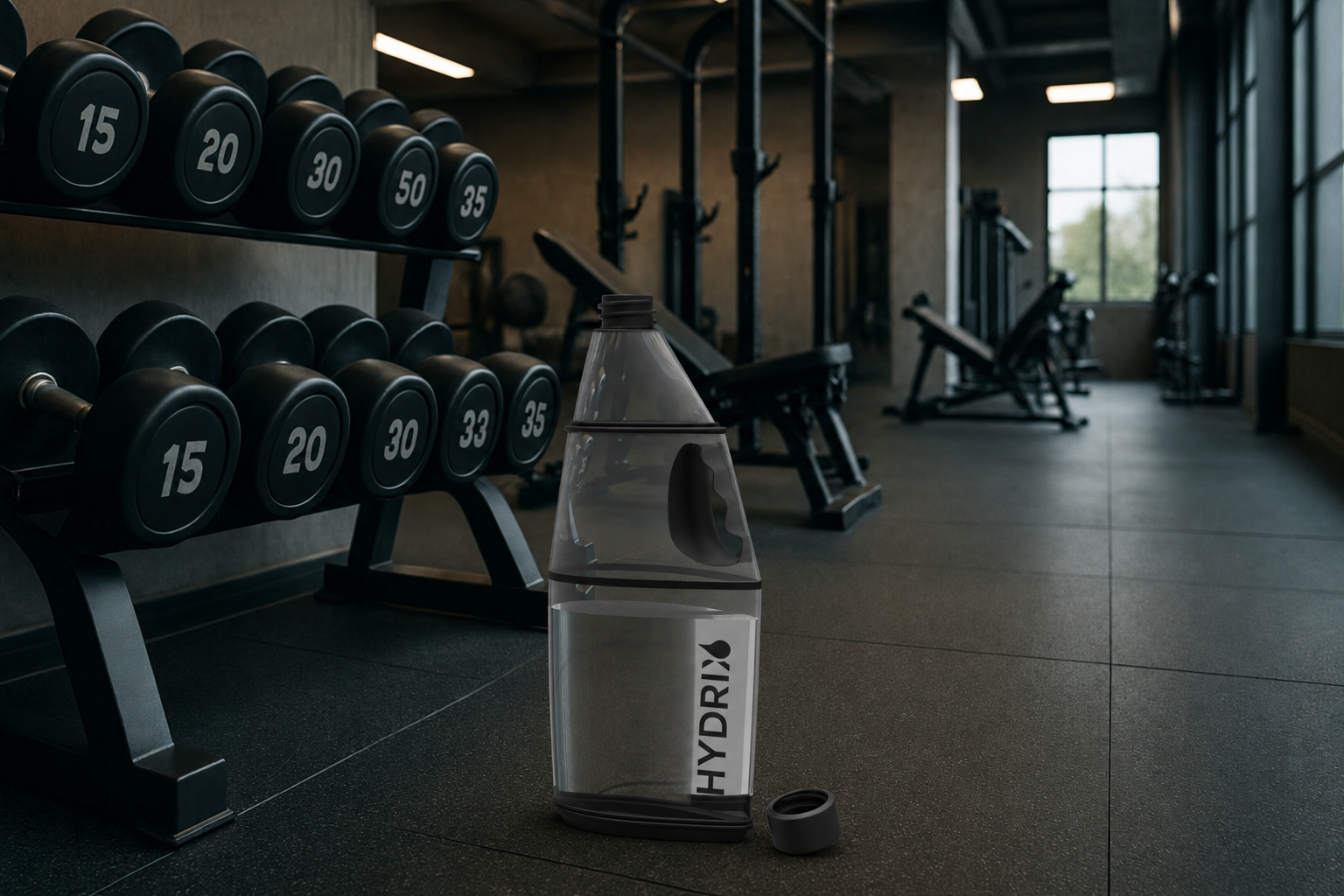
Hydrix visualised in a gym setting. The bottle was modelled by me in Autodesk Alias and rendered in KeyShot using an AI-generated background.
- Project type
- Industrial Design · CAD Modelling · Product Visualisation
- Course
- D0005A
- Year of study
- Year 4 of 5
- Duration
- Team
- Individual project
- My role
- Concept development, sketching, form development, surface modelling, CAD modelling, material exploration, rendering and visualisation
- Tools & methods
- Autodesk Alias · KeyShot · Sketching · Surface modelling · Construction curves · Surface skins · Freeform blends · Offset surfaces · Iterative form development · Product rendering
- Prototype
- Digital CAD model and KeyShot visualisations
Designed for the bag
As a student, I often carry a laptop, books and other relatively flat belongings. A traditional cylindrical bottle creates a bulky shape that fits poorly alongside them.
Hydrix was therefore designed as a one-litre bottle with a flatter, wider profile that sits more naturally against items inside a bag. Its asymmetrical form gives it a distinctive identity, while the integrated handle supports everyday carrying.
Concept and form direction
The initial concept was more complex than I could reliably develop with my experience in Autodesk Alias. Rather than abandoning it, I simplified the construction while preserving its central qualities: an asymmetrical silhouette, a flatter body and an integrated handle shaped around the fingers.
The result retained the intended identity and carrying function while becoming more manageable to develop as a surface model.
Developing the main form
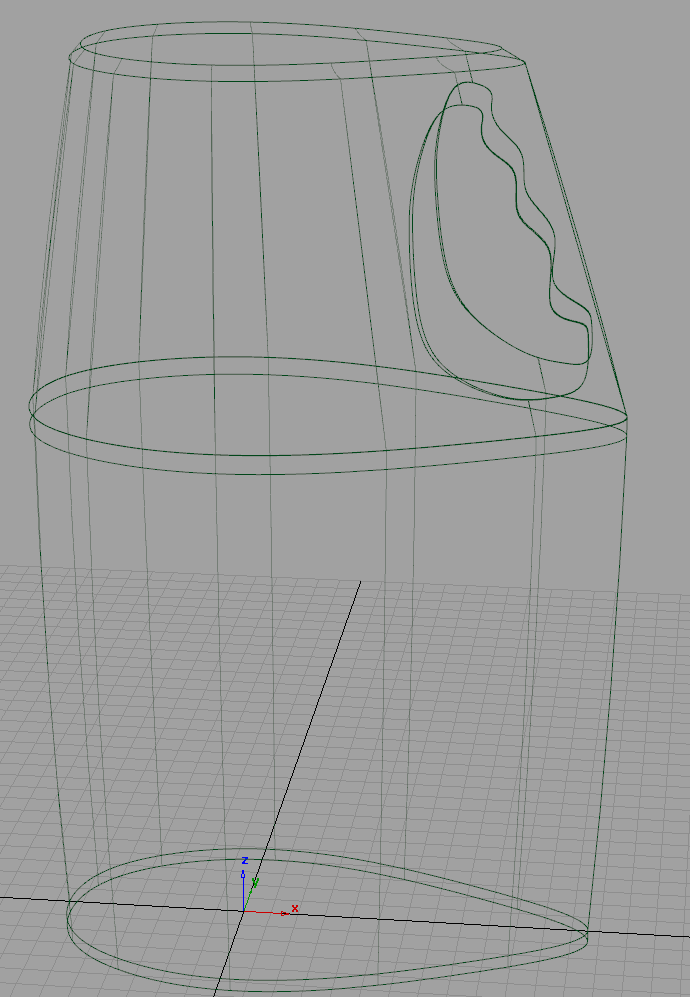
The bottle body was developed from construction curves placed at different heights to define its asymmetrical profile. Early surfaces created transitions that were too sharp and caused problems when offsetting the model.
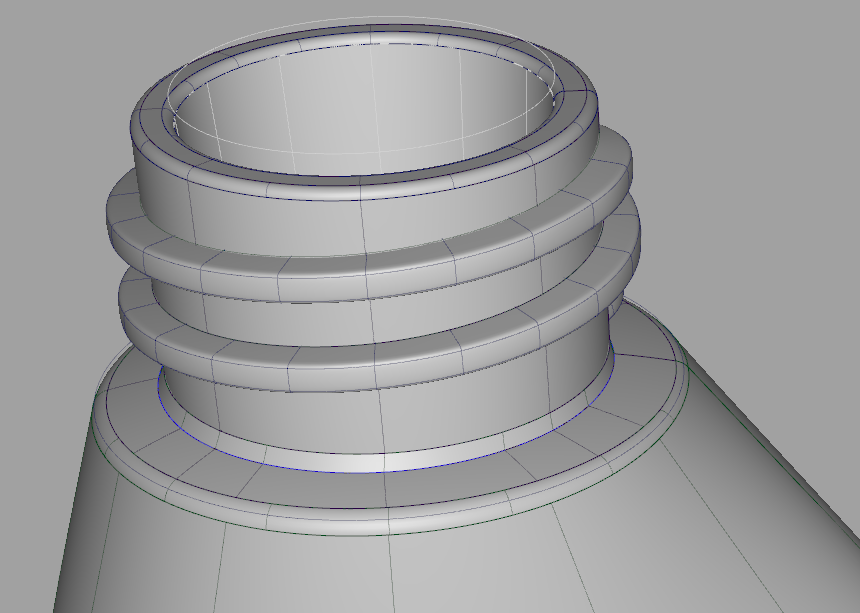
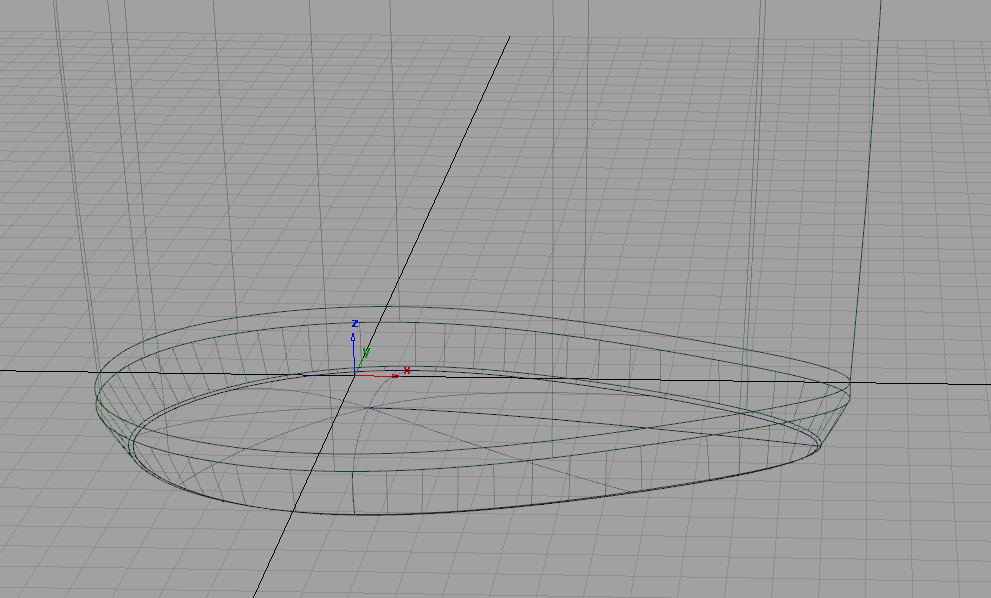
I rebuilt parts of the form using additional curves, freeform blends and slightly convex surfaces. This produced smoother transitions and a more stable foundation for the final model. The neck, opening and base were then developed from intersecting and adjusted surfaces to follow the main body.
Developing the handle
The integrated handle was developed from three CV curves. Early versions produced distorted surfaces and a grip that was thicker than intended.
By redrawing, rotating and repositioning the curves, I created a narrower U-shaped surface that followed the fingers more naturally. The final model communicates the intended carrying function, although further development would be needed for a fully resolved production solution.
Product details
Tubular details were added to strengthen the bottle’s visual identity and create continuity between the handle, body and base. Their materials and colours were later explored through different KeyShot variations.
Tap the markers to explore the details across the bottle.
Material and visualisation exploration
The completed CAD model was imported into KeyShot to explore materials, colour, lighting and context. Variations included silicone and stainless steel, as well as a transparent plastic body with harder plastic components and silicone details.
Lighting environments were adjusted to communicate the form and material transitions clearly, while the logo was positioned and tested in colours that complemented each material direction.
Hydrix in context
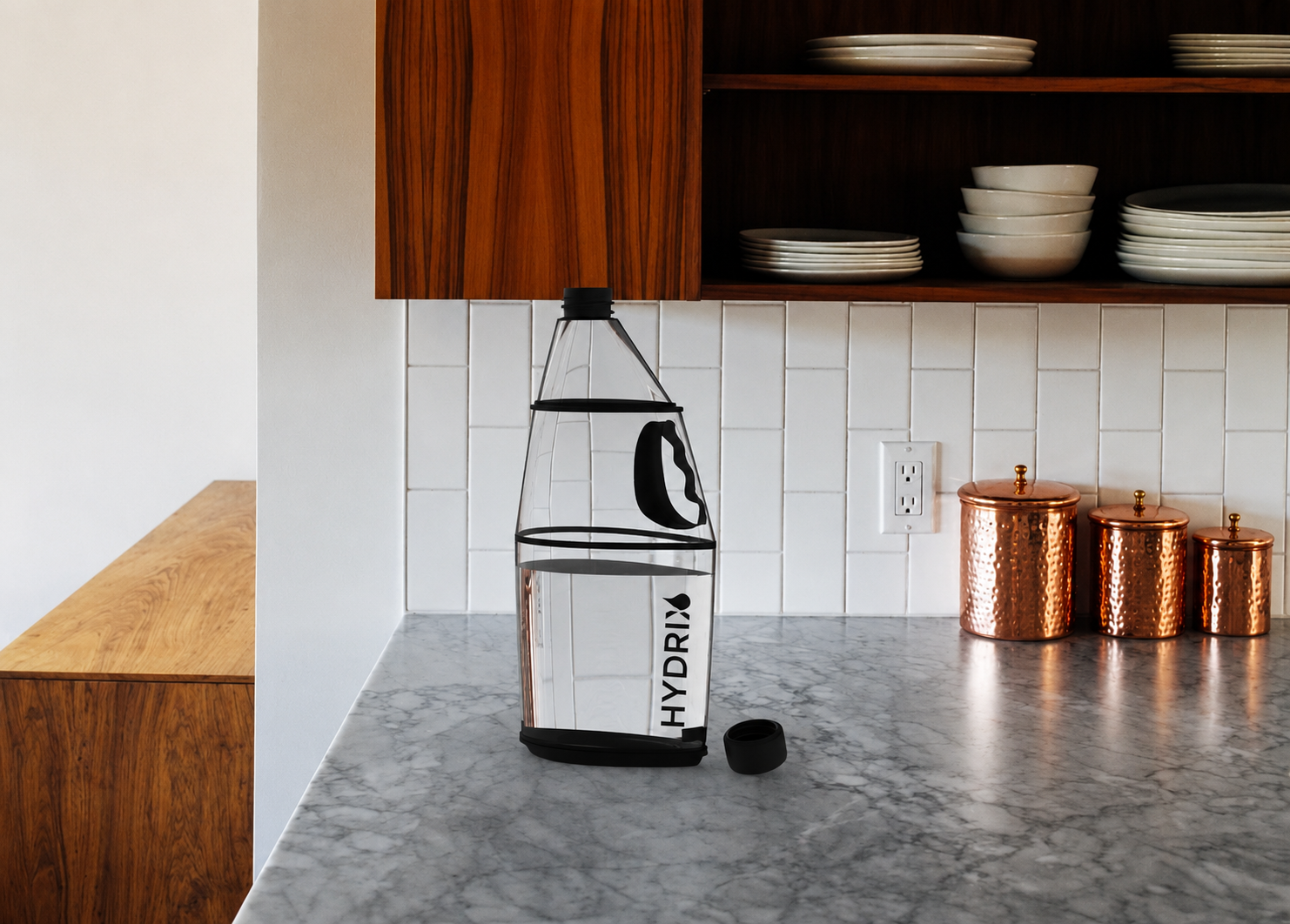
The contextual visualisations present Hydrix as part of an everyday routine rather than as an isolated CAD model. Office, gym, kitchen and bag settings were used to communicate both its broader use and its central purpose: fitting naturally alongside the belongings already carried inside a student or work bag.
Final outcome
Hydrix resulted in a complete digital CAD model, material studies and contextual KeyShot visualisations. The final concept combines a flatter one-litre body, an asymmetrical identity and an integrated handle designed for everyday carrying.
The project also marked a significant step in my development within Autodesk Alias. Rebuilding unstable surfaces and resolving technical problems strengthened both the model and my understanding of surface construction.
Key learnings
- Surface construction. I developed a stronger understanding of how construction curves, freeform blends and surface continuity affect the quality and stability of a model.
- Technical problem-solving. Rebuilding unstable surfaces and testing alternative constructions was often more effective than repeatedly trying to repair the original model.
- Visual communication. KeyShot showed me how materials, lighting and context influence the way a digital product concept is understood.
- Balancing ambition and feasibility. I learned to simplify an ambitious design direction without losing the central idea or identity of the product.